Early Life
Catherine Astrid Salome Freeman was born on 16 February 1973 in Mackay, Queensland. A proud Kuku Yalanji and Birri Gubba woman, she grew up in a sporting family. Her mother, Cecelia, had been a promising athlete before her opportunities were limited by the policies of the time. Her stepfather, Bruce Barber, recognised Cathy's talent early and encouraged her to pursue athletics.
Freeman began running competitively as a child and quickly showed exceptional promise. By the age of 16, she had won a gold medal at the 1990 Commonwealth Games as part of the 4x100 metre relay team, among the youngest Australians to win a Commonwealth Games gold medal.
Rise to the Top
Through the early 1990s, Freeman established herself as one of the world's leading 400-metre runners. She won the 400m gold at the 1994 Commonwealth Games in Victoria, Canada, where she famously carried both the Australian and Aboriginal flags during her victory lap, a moment that generated controversy at the time but which has since been recognised as a powerful gesture of pride and reconciliation.
She won consecutive World Championship gold medals in the 400m in 1997 (Athens) and 1999 (Seville), establishing herself as the clear favourite for the 2000 Sydney Olympics. She was named Australian of the Year in 1998.
The 2000 Sydney Olympics
On 15 September 2000, Cathy Freeman was chosen to light the Olympic cauldron at the opening ceremony of the Sydney Olympics, an honour that carried enormous symbolic weight for the nation. The choice of an Aboriginal woman to ignite the Games, on land that had been home to Aboriginal people for millennia, was a powerful statement about Australia's journey toward reconciliation.
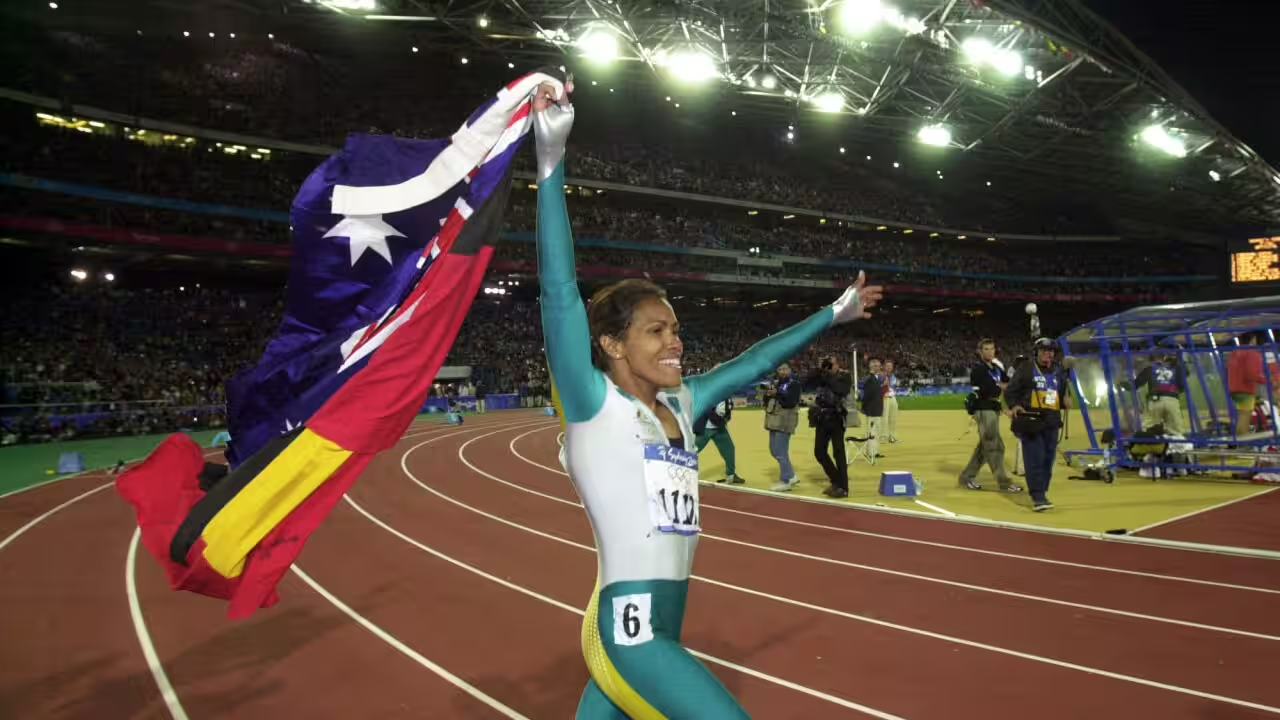
Ten days later, on 25 September 2000, Freeman lined up for the 400-metre final at Stadium Australia before a crowd of 112,524 and a television audience of billions. In a moment of extraordinary pressure and expectation, she won gold in a time of 49.11 seconds. She sat on the track in exhaustion and quiet reflection, then completed a victory lap carrying both the Australian and Aboriginal flags.
The moment is widely regarded as the single greatest moment in Australian sporting history.
Beyond Athletics
Freeman retired from competitive athletics in 2003. She established the Cathy Freeman Foundation in 2007, which works to close the gap in educational outcomes for Indigenous children in far north Queensland and the Palm Island community.
Her foundation focuses on attendance, literacy, numeracy, and overall engagement, working directly with Indigenous communities to support children's educational journeys.
Legacy
Cathy Freeman transcended sport to become a symbol of hope, pride, and reconciliation for all Australians. Her Olympic victory came at a time when Australia was grappling with questions of reconciliation and the treatment of Indigenous peoples, and her grace under extraordinary pressure helped unite a nation.
She was inducted into the Sport Australia Hall of Fame and continues to be one of the most admired and beloved Australians. Her story, from a young girl in Mackay to the Olympic podium, inspires Indigenous and non-Indigenous Australians alike.