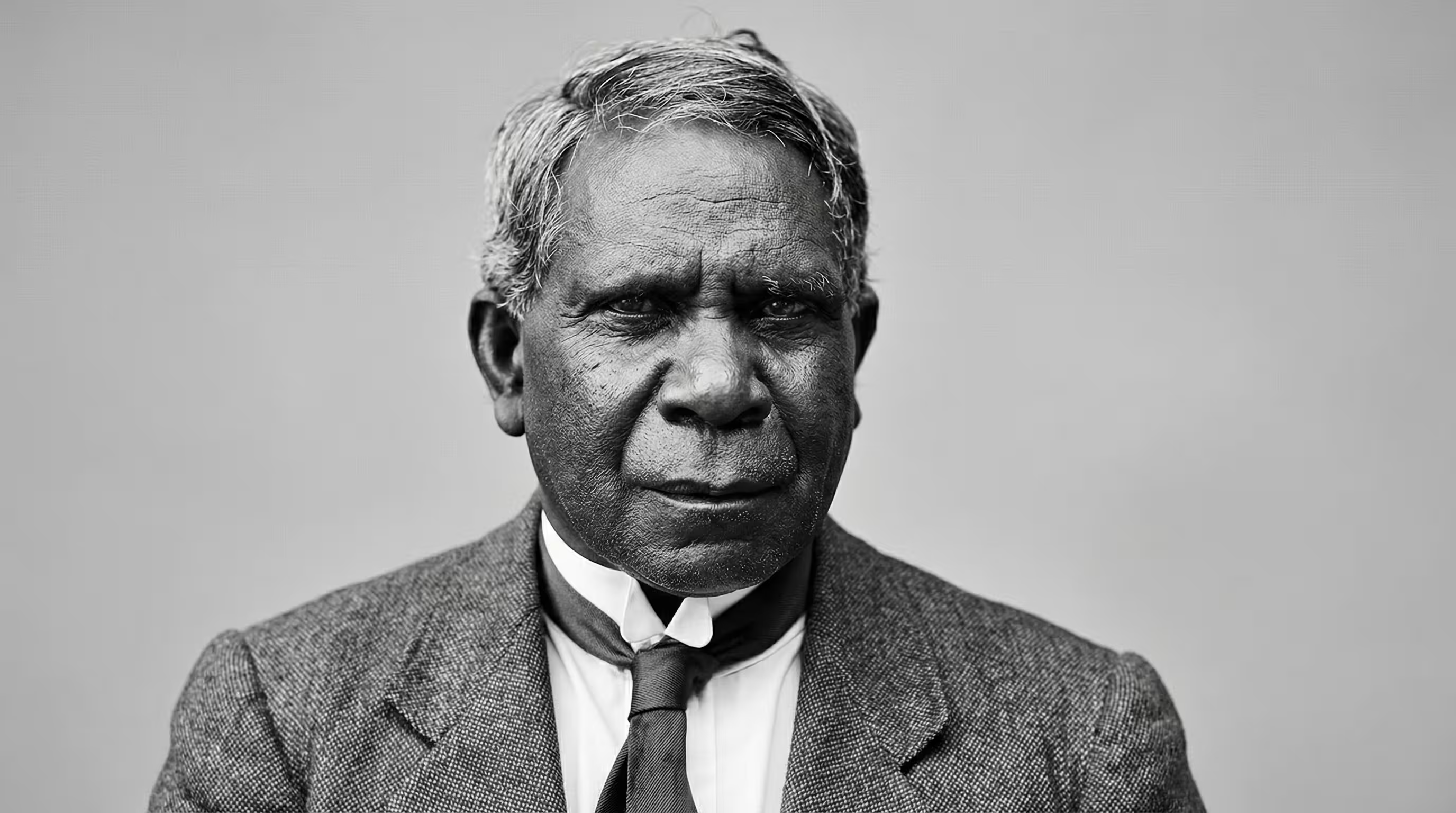
Early Life
David Unaipon was born on 28 September 1872 at the Point McLeay Mission in South Australia. A Ngarrindjeri man, he was the fourth of nine children born to James Ngunaitponi, a respected elder and Christian preacher, and Nymbulda. Growing up at the mission, he received a European education while also learning Ngarrindjeri cultural knowledge and traditions.
From a young age, Unaipon displayed a voracious intellect and insatiable curiosity. He was fascinated by science, philosophy, and mechanical engineering, teaching himself from books and by observation.
Inventor and Scientist
David Unaipon was a prolific inventor. He studied the principles of flight by observing the boomerang, and his research into its aerodynamic properties led him to design a helicopter-like flying machine in the early 1900s, predating Igor Sikorsky's helicopter by decades. While the patent for his modified hand-piece for sheep shearing was granted, many of his other inventions were documented but never formally patented.
His other inventions and designs included improvements to ballistics, a centrifugal motor, a multi-radial wheel, and mechanical devices for sheep shearing. His understanding of engineering principles was self-taught and remarkable for any era, let alone the early twentieth century in remote South Australia.
Writer and Storyteller
Unaipon was also a gifted writer and one of the earliest published Aboriginal authors. He collected and wrote down Ngarrindjeri legends and creation stories, working to preserve traditional knowledge in written form. His collection of Aboriginal legends was groundbreaking, though the manuscript was controversially published under another author's name during his lifetime.
He wrote extensively on Aboriginal culture, philosophy, and the connections between Aboriginal and Western knowledge. His writings demonstrated the sophistication and depth of Aboriginal intellectual traditions at a time when many Europeans denied Aboriginal people had any culture at all.
Advocate and Preacher
Throughout his life, Unaipon was a tireless advocate for Aboriginal rights. He travelled across southern Australia as a preacher and public speaker, arguing for improved conditions for Aboriginal people and for recognition of Aboriginal culture and intelligence.
He was a key figure in the campaign for Aboriginal citizens' rights and spoke out against the oppressive controls of the Protection Board. Despite facing constant racism and bureaucratic obstruction, he maintained his dignity and continued his advocacy well into old age.
Legacy
David Unaipon died on 7 February 1967. Since 1995, his portrait has appeared on the Australian $50 note, a fitting recognition for a man who embodied the intellectual richness of Aboriginal culture. He is the first Aboriginal person to appear on Australian currency.
The David Unaipon Award for Indigenous writers and the Unaipon Lectures at the University of Adelaide honour his memory. His life demonstrates that Aboriginal intellectual traditions are among the oldest and most sophisticated in the world, and that one person's determination to bridge cultures can leave an enduring mark.