Early Life
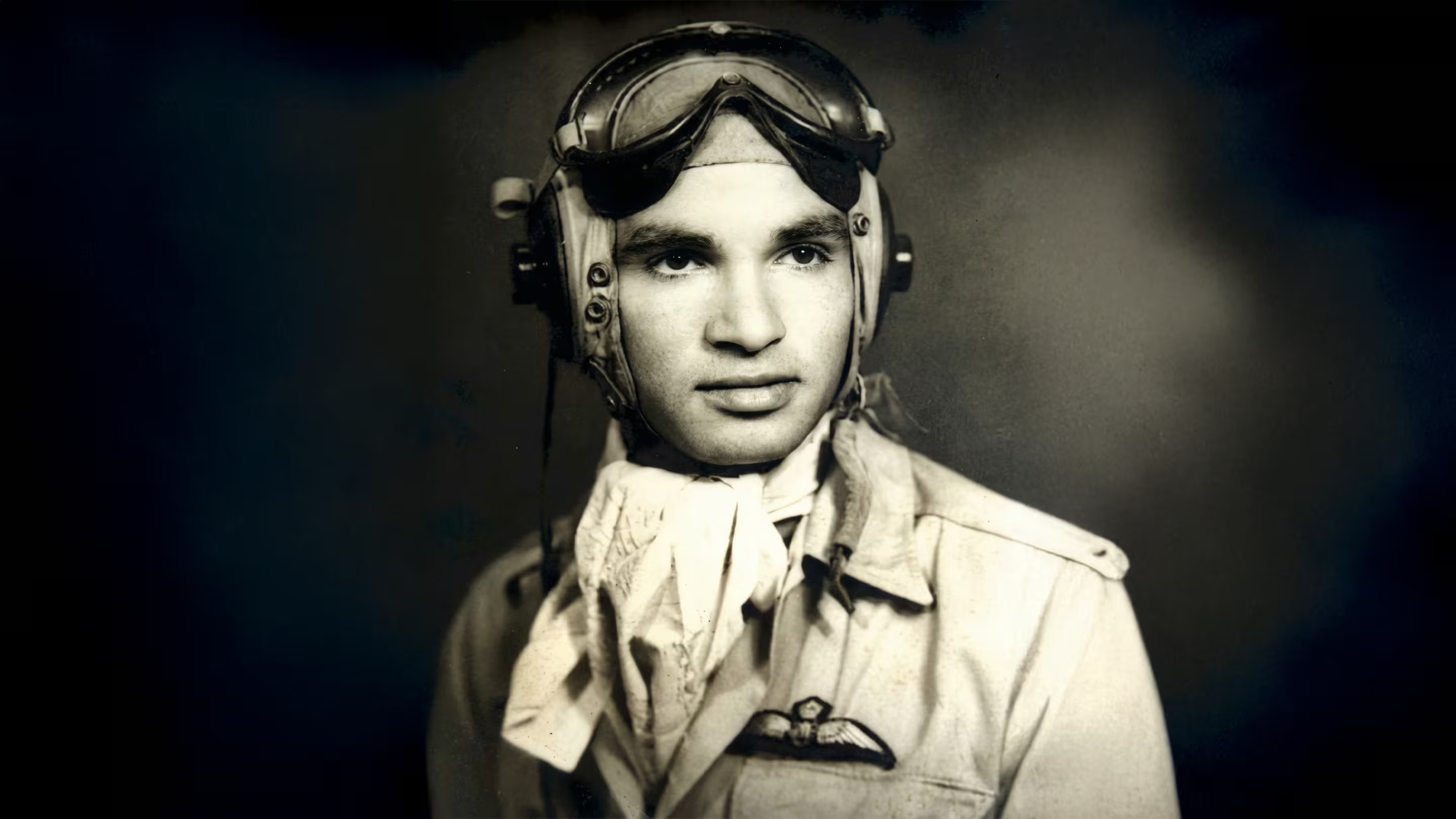
Leonard Victor "Len" Waters was born on 20 June 1924 at Euraba Aboriginal Mission near Boomi, New South Wales. A Gamilaraay man, he was the fourth of eleven children born to Donald Waters, a labourer, and his wife Grace Vera Bennet.
Waters was raised in the outback Queensland town of Nindigully, where he developed a fascination with aviation from a young age. He listened with admiration to news of the exploits of pioneering aviators Charles Kingsford-Smith and Amy Johnson. He left school before his 14th birthday to support his family and worked as a shearer before volunteering for RAAF service in 1942.
Military Service
Waters enlisted in the Royal Australian Air Force on 24 August 1942 at Brisbane. Initially training as an aircraft mechanic, he volunteered for flying duties and graduated as a sergeant pilot on 1 July 1944, finishing fourth in his course of forty-eight candidates—a testament to his aptitude, intelligence, dedication, and hard work.
He was posted to No. 78 Squadron in November 1944 and stationed at Noemfoor and Morotai in the Netherlands East Indies (now Indonesia), and later at Borneo. Waters flew 95 combat missions in his P-40 Kittyhawk fighter, which he named "Black Magic."
On one mission over Celebes (Sulawesi), his plane was struck by a shell that did not detonate but embedded behind the cockpit near a fuel tank. When returning to base, he alerted ground staff to the danger, later recalling that it was "the smoothest landing I've ever made."
Beyond his flying achievements, Waters also won the all-services middleweight boxing title while stationed on Morotai. By the end of the war, he had risen to the rank of warrant officer.
Post-War Challenges
After the war ended, Waters dreamed of starting a regional airline to connect people in the bush with the services and facilities of the city. However, his plan received no bank or government support, and he was forced to shelve the idea.
The lack of discrimination he had experienced within the RAAF failed to follow him once the uniform came off. Despite his distinguished service record, Waters was forced to return to his pre-war life of shearing and bush work, facing the systemic racism that Aboriginal Australians endured in civilian society.
Legacy
Len Waters died on 24 August 1993 following a fall near his home at Cunnamulla, Queensland, and was buried in the cemetery at St George.
His legacy has been honoured in numerous ways:
- 1995-96: Australia Post depicted his portrait on a stamp and his P-40 Kittyhawk "Black Magic" on an aerogramme as part of its Australia Remembers series
- 2009: Len Waters Estate suburb established in the City of Liverpool, New South Wales
- 2011: Sutherland Shire Council dedicated Len Waters Park at Barden Ridge, New South Wales
- 2020: A building at RAAF Base Williamtown was named in his honour
Waters' story represents both the remarkable achievements possible when barriers are removed and the tragic waste of potential when systemic racism prevents individuals from fulfilling their dreams.