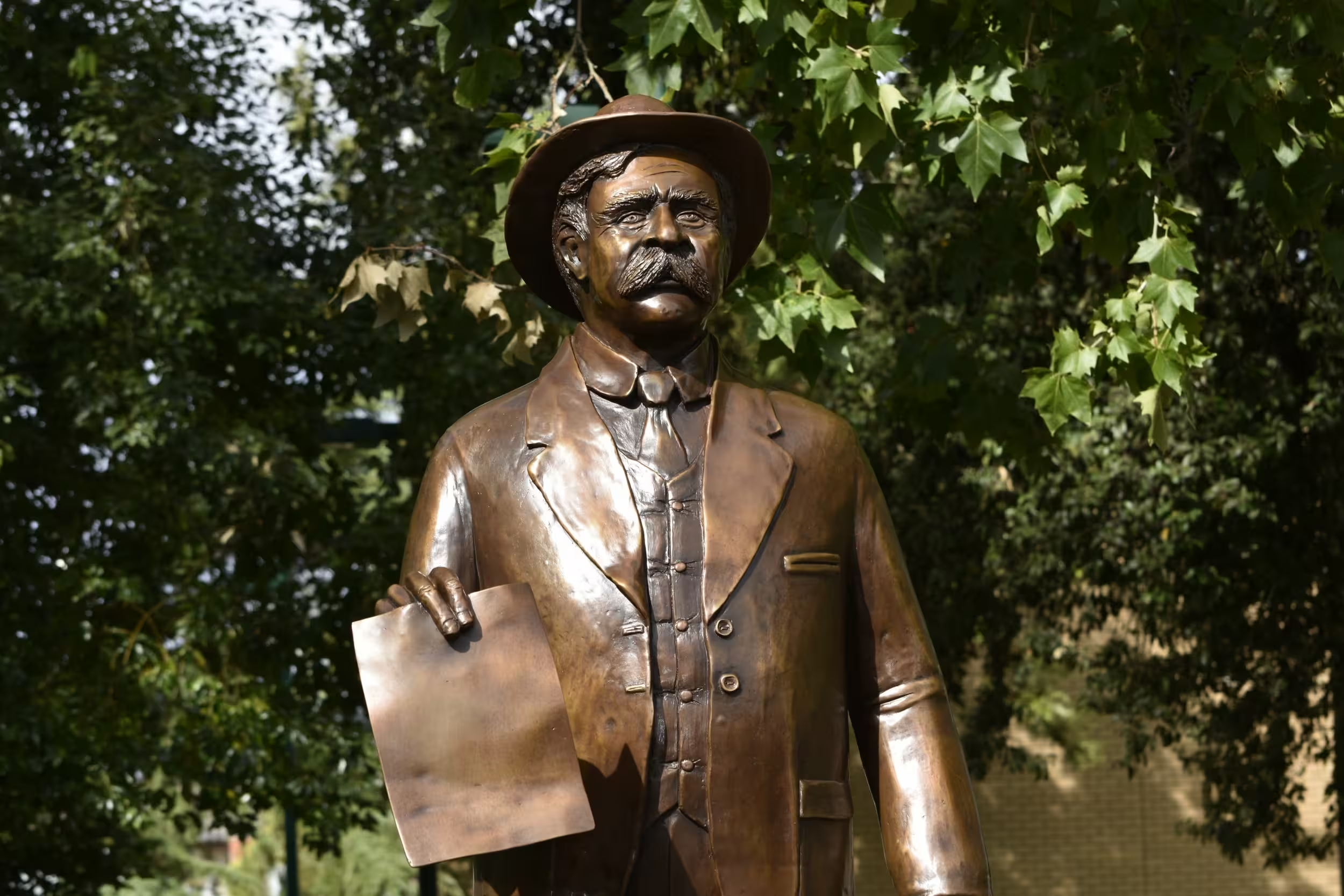
Early Life
William Cooper was born around 1860 at Yorta Yorta Country near Moama on the Murray River in New South Wales. A Yorta Yorta man, he grew up during a period of devastating dispossession, as pastoral expansion forced his people off their traditional lands. He worked as a shearer, drover, and labourer, the limited employment available to Aboriginal men.
Despite minimal formal education, Cooper was deeply intelligent and politically aware. He observed the systematic injustices inflicted on his people and resolved to fight for change through peaceful, democratic means.
The Australian Aborigines' League
In 1933, at the age of 73, Cooper founded the Australian Aborigines' League (AAL) in Melbourne, one of the first Aboriginal political organisations in Australia. Operating from his home in Footscray, he organised meetings, wrote letters, and built networks with sympathetic non-Aboriginal supporters.
The AAL campaigned for Aboriginal representation in Parliament, land rights, and an end to the oppressive control of Protection Boards. Cooper drew on his deep understanding of both Aboriginal law and European political systems to frame his arguments.
The Petition and Day of Mourning
Cooper's most ambitious campaign was a petition to King George V, calling for Aboriginal representation in the Australian Parliament and better conditions for Aboriginal people. He spent years collecting signatures, travelling across south-eastern Australia to gather support.
In 1937, the petition, bearing nearly 2,000 signatures, was presented to the Commonwealth Government for forwarding to the King. The government refused to submit it. By this time, the reigning monarch was King George VI, who had succeeded George V in 1936. Despite this crushing setback, Cooper continued his fight.
On 26 January 1938, the 150th anniversary of British colonisation, Cooper and the AAL helped organise the Day of Mourning in Sydney, alongside Jack Patten and William Ferguson. While white Australia celebrated, Aboriginal people gathered to mourn the loss of their lands, freedoms, and lives. It was the first major Aboriginal civil rights gathering in Australian history.
Protest Against Kristallnacht
On 6 December 1938, William Cooper led a delegation from the Australian Aborigines' League to the German Consulate in Melbourne to deliver a resolution protesting the treatment of Jewish people in Nazi Germany following Kristallnacht. This remarkable act of solidarity, by a people who were themselves victims of systemic oppression, is believed to be the only private, non-government protest against Kristallnacht anywhere in the world.
Cooper's protest was an extraordinary act of moral courage. At a time when his own people had no political rights and faced daily discrimination, he recognised the universal injustice of persecution and stood against it.
Legacy
William Cooper died on 29 March 1941, having spent the last decade of his life in tireless activism. For decades, his contributions were largely forgotten by mainstream Australia.
In recent years, Cooper's legacy has been powerfully reclaimed. In 2010, Israel's Yad Vashem Holocaust memorial formally recognised his Kristallnacht protest. The William Cooper Legacy Project has ensured his story is told. A memorial garden at Yad Vashem and a plaque at the former German Consulate in Melbourne honour his courage.
His life stands as a testament to the power of moral conviction and the Aboriginal tradition of standing up for justice, not only for one's own people, but for all who are oppressed.